
Injured runner series part 2A: causes of running injuries - training load
One of the most useful frameworks for understanding why runners get injured is the concept of training load management, specifically the relationship between how hard you are training right now versus how hard you have been training over the past several weeks. This balance is captured by a metric called the Acute:Chronic Workload Ratio (ACWR).
Before diving into the research, it helps to define a few terms. Your acute workload is simply the total training stress you have accumulated over the past week — taking into account both how long and how hard you trained.
Training stress = time spent training x session RPE = Arbitrary units (AU)
Your chronic workload is the rolling four-week average of that same measure, and represents your overall fitness base or what your body has become accustomed to handling. The ACWR is calculated by dividing your acute workload by your chronic workload. A ratio of 1.0 means your current week’s training matches your recent average — you’re doing what your body is used to. A ratio above 1.0 means you’re doing more than usual, and below 1.0 means you’re doing less.
So why does this matter? A 2020 study by Dijkhuis and colleagues published in the International Journal of Sports Medicine (1) examined this question directly in competitive runners — one of the first studies to do so in non-team sports. Over a 24-month period, 22 competitive Dutch runners (average 8.9±4.6 hours of running per week, and the average duration of a training session was 77.6±39.3 minutes) from the same training group tracked their daily training duration and perceived effort. This allowed the researchers to calculate workload and monitor the ACWR throughout the study period.
The findings were striking: 21 of the 22 runners sustained at least one time-loss injury during the study, meaning an injury serious enough to disrupt at least a full week of planned training. This alone tells us something important: running injury is not a rare bad luck event, even in a well-coached, structured training environment.
The key finding of the study was that it wasn’t simply how much a runner was training that predicted injury, it was how rapidly their training load was changing. Specifically, even a modest increase in the ACWR over a two-week period (a change between 0.10 and 0.78) was associated with a 4.5-fold increase in injury risk. A similar pattern was seen when looking at week-to-week changes two to three weeks before an injury, which carried a 2.7-fold increase in risk. Importantly, the authors also observed a roughly two-week delay between the increase in training load and the injury actually appearing, meaning that by the time you feel something go wrong, the damage may have been accumulating for weeks.
It is worth noting that the authors were careful not to overstate their findings. While the ACWR was a useful signal for elevated injury risk, it was not a reliable standalone predictor of injury — meaning a rising ACWR doesn’t guarantee you will get hurt, and a stable ACWR doesn’t guarantee you won’t. Injury is multifactorial, and load is just one piece of the puzzle.
Allow me to sketch out two different scenarios which may help clarify these findings in practical terms:
We have a high level runner who averages 8 hours of running per week (80 minutes per session, 6 sessions per week) with an average intensity of 12 RPE per session (Borg scale 6-20). This would equate to an AU average of:
480 minutes x 12 RPE = 5760
Assume this was the average over the previous 4 weeks, so it would be our chronic workload anchor of 1.0 (in this case, 5760).
Now, if this runner builds gradually every over this 4 week block we would get something like this:
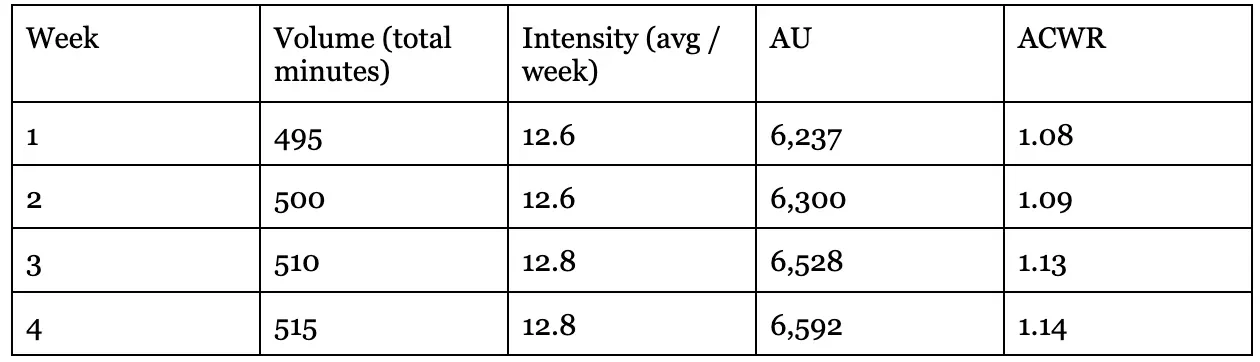
According to the findings from this study, this is well below the 0.10 and 0.78 change in ACWR over a 2-week period.
However, if this runner builds more quickly over this 4 week block, we would get something like this:
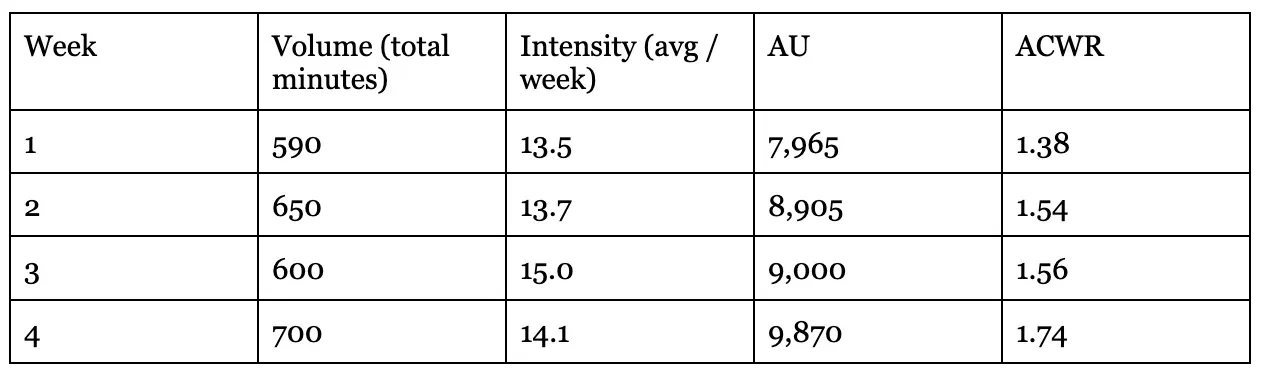
According to the findings from this study, this falls in the range with a 4.7x increase of injury (0.10-0.78) compared to the previous two weeks.
What does this mean for you as a runner? The practical takeaway is that we should be encouraging runners to build up slowly. This is true both in terms of running volume and running intensity. Because quantifying both together is challenging, using the AU equation is a helpful place to start. The bottom line: build slowly, protect your chronic fitness base, and treat sudden increases in training as a warning sign worth paying attention to.
It is worth noting that the this is a small sample size (22 runner) in a pretty elite training group. I don’t think this makes the findings invalid, but we would be wise to use this information in our training programs. Especially because these findings have been replicated in other sports.
In the next post, I will get into “Part B: Previous History of Injury” as the research consistently points to this as a major risk factor for sustaining a running related injury.
Thanks for reading!
When selecting a training program, you need to ensure that weeks and months of training are progressed appropriately! To learn more about our training programs, click below!
