
Injured runner series part 1: what are the common injuries runners deal with?
In this post, we will cover the most common running-related injuries (RRI). But first, we need a shared understanding of what actually constitutes a running-related injury. Seems simple enough, but it was surprisingly challenging to find an agreed upon definition in the research. Let’s dive in.
The Definition Problem
Unfortunately, the research has yet to settle on an agreed-upon definition, and most of the systematic reviews and meta-analyses (pooled studies) I came across suffer from what researchers call heterogeneity. This means that the studies included in these reviews differ, often substantially, in how they define running-related injuries, and that’s a significant problem problem.
A Delphi study from 2015 (a panel of experts convened to reach consensus — more on this below) noted in its introduction (1):
“Currently, the rates of prevalence and incidence of running injuries vary between 19% and 92%, depending on the injury definition adopted. Some of the disparities in injury rates are certainly linked to the differing definitions used in each study.”
The authors go on to illustrate this with a striking example:
“Bovens et al. used a broad definition — any physical complaint developed in relation to running that causes restriction in running distance, speed, duration, or frequency — and found an injury incidence of 84.9%. Blair et al., on the other hand, used a much narrower definition — an injury that causes the runner to stop running for at least seven days — and found an incidence of just 24%.”
A reader of the Bovens study walks away thinking that nearly 9 out of 10 runners get injured, while a reader of the Blair study thinks it’s closer to 1 in 4. Someone who is risk-averse might avoid running altogether based on the higher figure.
The Delphi consensus invited 112 researchers from studies identified in a previous systematic review. Thirty-eight participants from nine countries were selected, and consensus required greater than 75% agreement. The group ultimately landed on the following definition, approved by 80% of participants:
Running-related (training or competition) musculoskeletal pain in the lower limbs that causes a restriction or stoppage of running (distance, speed, duration, or training) for at least 7 days or 3 consecutive scheduled training sessions, or that requires the runner to consult a physician or health professional.
This is a clear and reasonable definition — but it still isn’t consistently applied across the research. Add to that the inconsistency in how researchers define runner “level” (novice, recreational, amateur, elite), often without any objective measure of training volume or intensity to support those labels, and you can see why comparing studies is so difficult.
The takeaway: when you encounter a statistic about running injury rates, that number is only as meaningful as the definition behind it. As a general rule, astronomically high injury rates tend to reflect a very loose definition of “injury.” It is necessary to understand how researchers are defining terms in their study.
What the Research Actually Shows
With that context in mind, I want to highlight a 2019 systematic review (2), that I consider relatively high quality, though it shares many of the same limitations - the definition problem - as the research discussed above.
Rather than focusing on injury incidence (the proportion of runners who develop an injury for the first time over a defined period) or prevalence (the proportion of runners who have an injury at a specific point in time, regardless of when it started), the authors instead focus on the proportion of injuries by anatomical site, with a secondary aim of identifying specific pathologies where possible.
Their reasoning for answering this clinical question is that prevalence limits the analysis to studies that include a medical diagnosis, while focusing on incidence requires accurate estimates of exposure. By stepping back from both, the researchers were able to draw from a larger pool of studies — though they acknowledge this opens the door to greater bias.
Some relevant inclusion criteria from this study:
Published peer-reviewed prospective cohort, retrospective cohort, cross-sectional, or randomized controlled trials
Reported injury data in runners over 18 years of age
Included novice, recreational, amateur, elite, triathlete, and orienteering runners
Competing in distances greater than 800m and up to the marathon
Provided the anatomical location of lower limb running injuries
Presented data as running injury or any lower limb pain regardless of its interference with running
As you can see, we can’t fully escape the definition problem. We also have a study that pools a bunch of runners of different calibers and ages and even include athletes for whom running isn’t their sole focus (ie triathletes and orienteering athletes). Let’s proceed to look at the data with those caveats in mind.
Injuries by Anatomical Location
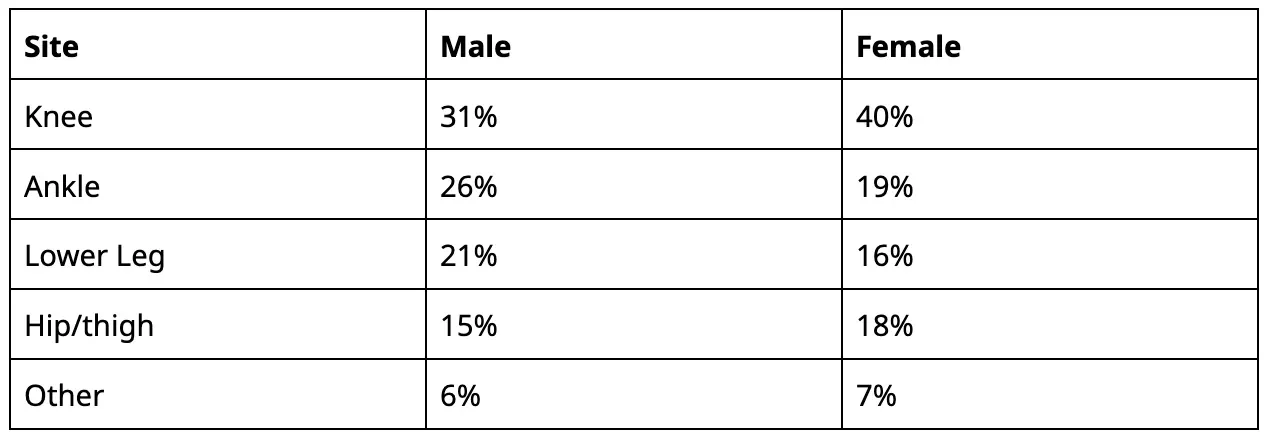
Injury proportions by anatomical location were calculated from 10,688 injuries across 18,195 runners in 36 studies. Here is what they found:
Injuries by Specific Pathology
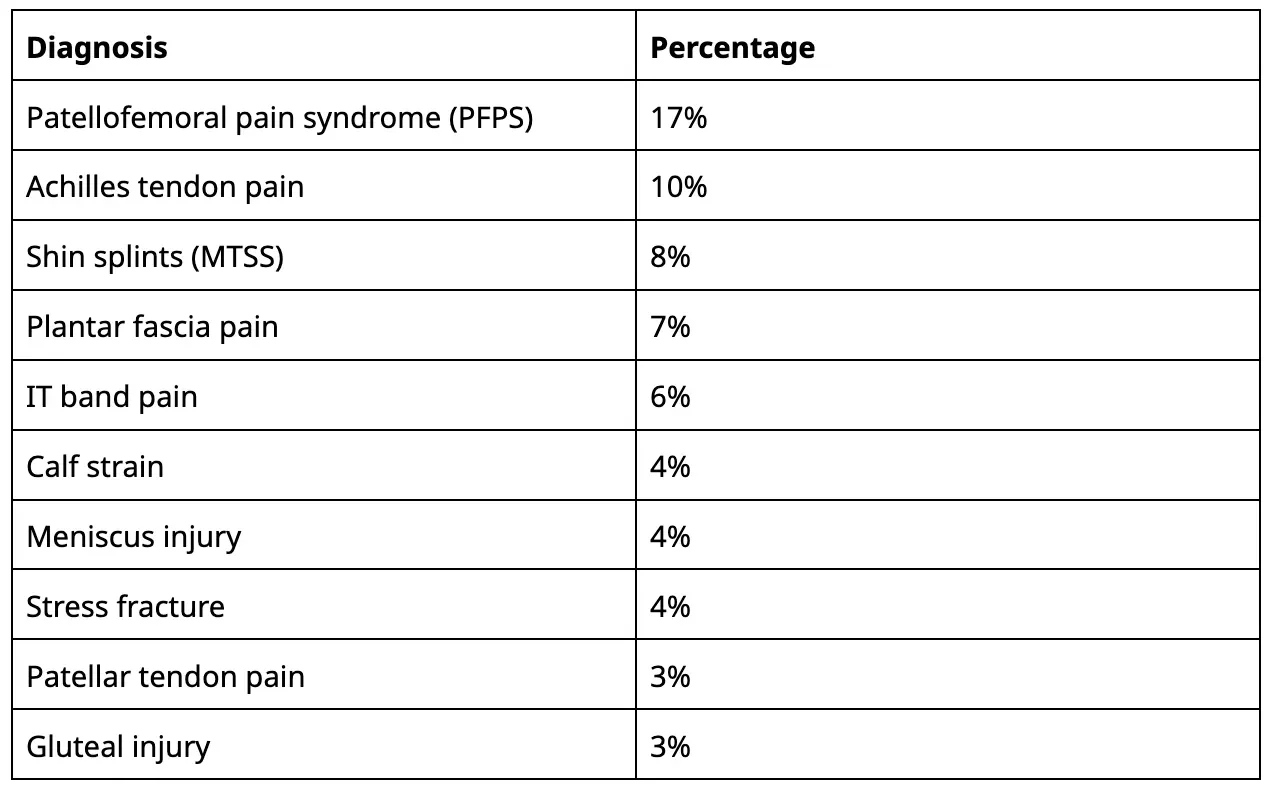
Injury proportions by specific pathology were calculated from 3,580 injuries reported by 4,752 runners. Here is what they found:
Key Takeaways
Despite its limitations, this study offers some meaningful insights. Roughly 70% of running-related injuries occur at or below the knee — a finding that is consistent with previous research, which adds weight to the conclusion. The top three most common diagnoses (PFPS, Achilles tendon pain, and MTSS) are also consistent with earlier studies.
This pattern matches what I see in the PT clinic. I also tend to agree that females appear to have higher rates of knee pain compared to males, while males show slightly higher rates of injury to the lower leg and foot/ankle. On the whole, I think this research is genuinely useful and can inform how clinicians and coaches design programs to reduce injury risk.
That said, I suspect injury location may differ meaningfully between elite and non-elite runners, and between those training at lower intensity and higher volume versus higher intensity and lower volume. These nuances are difficult to capture in the current body of research.
One final note: I intentionally did not comment on findings that report “X% of runners get injured each year” or similar statistics, for the reasons outlined above regarding the definition problem.
Why This Matters
My hope is that this post does three things:
First, it gives you a clearer picture of the messy reality of running injury research, and some insight into why the commonly cited injury numbers vary so widely. When one source claims 9 out of 10 runners get injured and another says 1 in 4, both can be citing real studies. The difference is in how “injury” was defined.
Second, it orients you to the most common injury locations and specific diagnoses runners experience. That knowledge can meaningfully inform how we design training plans to reduce the risk of the injuries that actually sideline people most often.
Third, it brings awareness to the complexing of research studies and some of the inherent flaws that occur when studies are pooled. I think that very often, well intentioned people read abstracts and share the findings with friends on social media, or journalists report findings to news outlets, without proper context. This leads folks to come to conclusions that aren’t actually supported by research in the way they think it is.
As a physical therapist I can’t read this study and think that it applies directly to the marathoner in front of me running 70 miles per week. However, it should be one data point in a set of larger data points that informs my clinical decision making.
Thanks for reading 🙏
All of these injuries are subject to improving by following a solid training plan. Click below to browse all of our current program offerings:
