
Zone 2 training: cutting through the confusion
If you’ve spent any time on social media or listened to health podcasts lately, you’ve probably heard Zone 2 training hyped as the secret weapon for longevity, fat burning, and mitochondrial health. The message is simple and seductive: train slow to get fast, optimize your mitochondria, and live longer.
However: a recent review published in Sports Medicine (1) throws some serious cold water on these claims. And yet, when we look at what elite athletes actually do, Zone 2 still plays an important role (2,3). So what gives?
Let’s untangle this mess.
What does zone 2 refer to?
“Zones” are training zones. They are usually delineated based on % of heart rate (HR) max, % of HR at lactate threshold, or % Vo2 max. Below is an example similar to that seen on zone calculators like the 80/20 Endurance website: (4)
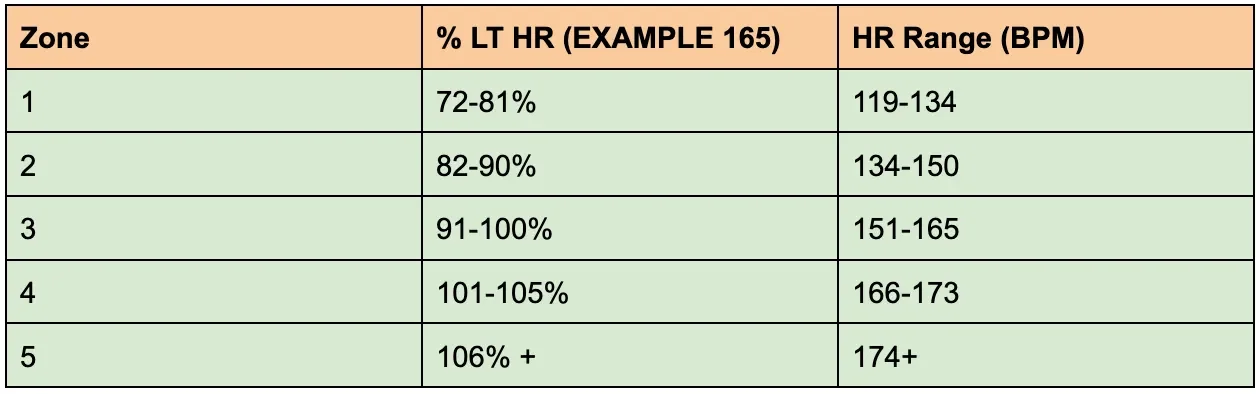
In this case, training zones are created by using % of Lactate Threshold Heart Rate (LT). In this example, zone 2 is around 81-90% of HR @ LT. In other cases (not pictured), it might be defined around 60-70% of HR max, or % of Vo2 max or 1.5-2.0 mmol of lactate. Yes, this is confusing. And to make it even more confusing, some coaches use a three zone or seven zone system rather than a 5 zone system. So, there is certainly a definition problem, but we will proceed through this blog as best we can. For what it is worth, I prefer to use % of lactate threshold in my own training and the athletes I have coached.
Zone 2: The Special Zone?
According to popular media, Zone 2 training is supposed to be the optimal intensity for improving mitochondrial function and fat oxidation. The reasoning goes: elite endurance athletes do tons of low-intensity training and have exceptional mitochondria, therefore low-intensity training must be what builds those mitochondria.
Sounds logical, right? Except correlation isn’t causation.
What the Science Actually Shows
A new narrative review by Storoschuk and colleagues (1) titled “Much Ado About Zone 2” systematically examined whether Zone 2 training lives up to the hype for the general population. Their findings are eye-opening:
On Mitochondrial Capacity
The conclusion from the authors was “Our review failed to uncover substantive evidence supporting claims that Zone 2 is superior to higher exercise intensities for improving mitochondrial and fat oxidative capacity, a result possibly driven by the lack of studies”
Below are some of the findings from their review:
Zone 2 exercise produces minimal and inconsistent activation of mitochondrial biogenic signaling pathways
Studies show either no change or modest improvements in mitochondrial capacity after Zone 2 training
High-intensity interval training (HIIT) consistently produces greater activation of key signaling molecules like AMPK and shows superior mitochondrial adaptations
A meta-analysis found that exercise below 60% of maximum work rate (roughly Zone 2 for many people) doesn’t improve mitochondrial content or respiratory capacity
As the authors note: “Despite ongoing debate surrounding the role of intensity as a key mediator of exercise-induced mitochondrial adaptations, it is well established that high-intensity interval training induces robust mitochondrial adaptations.”
On Fat Oxidation
The story here is slightly better but still nuanced. Zone 2 training can improve fat oxidation capacity, particularly in sedentary or obese individuals. However:
High-intensity training also improves fat oxidation
Meta-analyses show either no difference or small advantages for HIIT compared to moderate-intensity continuous training
For trained athletes, Zone 2 training alone may not be sufficient to drive further improvements
On Cardiorespiratory Fitness
This is where things get really interesting. VO₂max—one of the strongest predictors of cardiovascular disease risk and all-cause mortality—responds better to higher-intensity training:
Multiple studies show greater improvements in VO₂max with intensities above Zone 2
For trained athletes, Zone 2 training often produces no further gains in VO₂max
Higher intensities are critical for maximizing cardiometabolic health benefits
The review’s conclusion is blunt: “Evidence suggests prioritizing higher exercise intensities (> Zone 2) is critical to maximize cardiometabolic health benefits, particularly in the context of lower training volumes.”
But Wait—What About Elite Athletes?
Here’s where it gets confusing. If Zone 2 isn’t the magic bullet, why do elite endurance athletes spend 75-80% of their training time at low intensities?
This is the critical question, and the answer comes from understanding what elite athletes actually do versus what gets recommended to the general public.
The 80/20 Rule That Actually Works
Research on training intensity distribution in elite athletes reveals a consistent pattern. As Stephen Seiler documented in his landmark 2010 review(3) , successful endurance athletes training 10-13 times per week typically follow this distribution:
~80% of training sessions at low intensity (< 2 mmol/L lactate)
~20% of training sessions dominated by high-intensity work (interval training at ~90% VO₂max)
This pattern—often called polarized training—shows up again and again:
Elite Norwegian rowers (Fiskerstrand & Seiler)
World-class junior rowers (Guellich et al.)
Spanish distance runners (Esteve-Lanao et al.)
Professional cyclists (Zapico et al.)
Elite marathoners (Billat et al.)
Why the Polarized Approach Works for Athletes
A comprehensive scoping review by Rivera-Köfler and colleagues examined 15 studies comparing polarized training to other approaches. Their findings:
For elite/international and world-class athletes (tiers 4-5):
Polarized and pyramidal training models showed superior results
These models were more effective than threshold-heavy approaches
Performance improvements were significantly better
For trained/developmental athletes (tiers 2-3):
Differences between training models were negligible
Multiple approaches worked equally well
Total training volume mattered more than specific distribution
The key insight: elite athletes don’t do 80% Zone 2 training because it’s magically superior for mitochondria. They do it because:
Volume tolerance: You can’t do 10-15 hours per week of high-intensity training without breaking down
Technical mastery: Long, slow miles build sport-specific skills and efficiency
Complementary adaptations: The combination of high volume low-intensity work with targeted high-intensity sessions optimizes both peripheral (muscle) and central (cardiovascular) adaptations
Stress management: Low-intensity training allows for rapid recovery between hard sessions, enabling twice-daily training
As Seiler notes: “The predominance of low-intensity, long-duration training, in combination with fewer, highly intensive bouts may be complementary in terms of optimizing adaptive signaling and technical mastery at an acceptable level of stress.”
Key Takeaways:
I don’t think the “Much Ado About Zone 2” would dissuade me from doing more lower intensity training (ie Zone 2), and here is why:
If you only have 30 minutes to train, the evidence is clear that 30 minutes at zone 4/5 outweigh the benefits at zone 2. But, this is not the situation most people find themselves in.
If You’re Training for General Health and NOT training for an endurance event:
Don’t obsess over Zone 2. The Storoschuk review is clear: for people with limited training time, prioritizing higher intensities is more effective for:
Improving VO₂max
Enhancing mitochondrial function
Maximizing cardiometabolic health benefits
Improving performance
This doesn’t mean skip easy days entirely. But it does mean you shouldn’t replace your high-intensity work with more Zone 2 because a podcast told you it’s better for your mitochondria.
If You Are Training For an Endurance Event:
The polarized approach makes sense. We don’t need to reinvent the wheel. There is a reason no recent winners of the Boston Marathon (or any major marathon for that case) train a large percentage of their weekly training volume at high intensity. Zone 2 (and lower intensity training) provide immense benefit. Primarily, it allows you to run larger weekly volumes which is directly linked to running (and all endurance) performance.
Final Takeaway
Zone 2 may have been too overhyped by fitness influencers and podcasters. It was touted as “the most important training zone”. For the general public here is the TLDR:
What I wouldn’t advise based on the findings of this article
Day 1: 30 minutes zone 2
Day 2: 30 minutes zone 2
Day 3: 30 minutes zone 2
You would get more benefit from (with less time)
Day 1: 30 minutes with higher intensity intervals
Day 2: 30 minutes zone 1-2
Day 3: 30 minutes with higher intensity intervals
But if the individual has more time I would really prefer:
Day 1: 30 minutes with higher intensity intervals
Day 2: 50 minutes zone 2
Day 3: 75 minutes zone 2
The article did not specify that 30 minutes of zone 4/5 is better than 60-75 minutes at Zone 2. I believe for most folks, volume still trumps intensity when it aligns with someones schedule. I think for elite athletes or recreational runners with competitive goals, there really isn’t a debate to be had. Volume is still king.
Want to see how Zone 2 should be structured in actual programs? Check out our programs below!
